Cookware Materials Explained: Stainless Steel, Aluminum, Non-Stick & More
Choosing the right cookware material can have a major impact on cooking performance, heat distribution, durability, maintenance, and the overall cooking experience. Pots, pans, saucepans, frying pans, and cookware sets are manufactured from a variety of materials, with each offering different advantages.
The most common cookware materials include stainless steel, aluminum, non-stick coated metals, cast iron, carbon steel, and combinations of multiple metals. Modern cookware can also use layered or clad construction to combine the advantages of different materials in a single product.
Understanding these materials makes it easier to understand why one cookware product behaves differently from another.
What Is Cookware Made From?
Cookware is manufactured using materials selected for properties such as heat conductivity, durability, corrosion resistance, weight, food compatibility, and ease of maintenance.
Some materials transfer heat quickly, while others retain heat for longer periods. Some provide naturally durable cooking surfaces, while others use coatings to create a smoother, easier-release surface.
Modern cookware manufacturing can also combine different materials. For example, a stainless steel pan may contain an aluminum layer because aluminum transfers heat efficiently while stainless steel provides durability and a stable cooking surface. This type of multi-layer construction is commonly referred to as cladding.
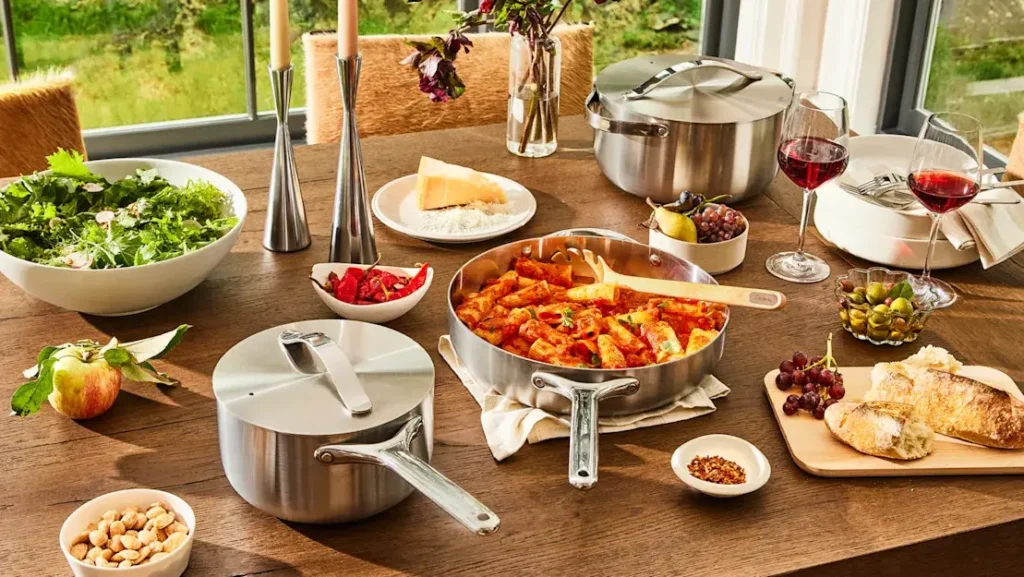
Let’s look at the most important cookware materials in more detail.
Stainless Steel Cookware
Stainless steel is one of the most widely used materials for cookware because of its durability, versatility, and resistance to corrosion.
Stainless steel cookware is commonly used for frying pans, saucepans, stock pots, cooking pots, cookware sets, and professional kitchen equipment.
One of its major advantages is its durability. A well-made stainless steel cooking surface can withstand regular use without relying on a non-stick coating.
Stainless steel is also valued because it does not easily react with many foods. It is particularly useful for cooking techniques such as browning, sautéing, boiling, simmering, and braising.
Advantages of Stainless Steel
Stainless steel cookware offers several benefits:
- Excellent durability
- Corrosion resistance
- Easy maintenance
- Professional appearance
- Versatile cooking performance
- Suitable for many cooking methods
- Available in different thicknesses and constructions
- Compatible with induction when appropriately designed
However, stainless steel itself does not conduct heat as efficiently as some other cookware materials. This is why many manufacturers use layered construction, incorporating materials such as aluminum into the cookware body or base.
This combination can improve heat transfer while maintaining the durability of stainless steel.
Aluminum Cookware
Aluminum is known for its excellent heat conductivity and relatively lightweight construction.
Because aluminum transfers heat quickly, it is commonly used in cookware designed for responsive temperature control.
Aluminum can be found in frying pans, saucepans, baking products, commercial cookware, and cookware with non-stick coatings.
Another important characteristic is its relatively low weight compared with many other metals.
Aluminum Cookware and Heat Distribution
Heat distribution is an important part of cookware performance.
A well-designed aluminum cookware body can distribute heat efficiently across the cooking surface, helping reduce localized hot spots.
This makes aluminum particularly useful for products designed for sautéing, frying, simmering, and other cooking techniques where consistent heating is important.
Aluminum can also be combined with other materials. For example, an aluminum core can be enclosed by stainless steel to combine efficient heat transfer with a durable cooking surface.
Non-Stick Cookware
Non-stick cookware is generally manufactured by applying a specialized coating to a metal cookware body.
The underlying cookware may be aluminum, stainless steel, or another suitable material, while the coating provides a cooking surface designed to reduce food sticking.
Non-stick cookware is particularly popular for foods such as eggs, pancakes, fish, and other delicate ingredients.
One of its major advantages is easy food release and easier cleanup.
How Non-Stick Cookware Works
The coating creates a smoother cooking surface between the food and the underlying cookware material.
This means that less food residue remains attached to the cooking surface during normal use.
However, non-stick cookware requires appropriate care.
Metal utensils and abrasive cleaning materials can damage some non-stick surfaces. Manufacturers commonly recommend softer utensils such as silicone, nylon, wood, or plastic and gentle cleaning methods.
Non-Stick Cookware Applications
Non-stick cookware is commonly used for:
- Frying pans
- Omelet pans
- Saucepan interiors
- Cooking sets
- Crepe pans
- Specialty cooking pans
Its easy-release characteristics make it especially useful in kitchens where convenience and easy cleanup are priorities.
Cast Iron Cookware
Cast iron is a traditional cookware material known for its ability to retain heat.
Unlike lightweight cookware materials that respond quickly to changes in temperature, cast iron tends to hold heat for longer periods.
This makes it useful for cooking techniques such as:
- Searing
- Roasting
- Slow cooking
- Frying
- Braising
- Baking
Cast iron cookware can be extremely durable when maintained properly.
Traditional cast iron may require seasoning to help protect the surface and improve cooking performance. Proper drying is also important because exposed cast iron can develop rust if left wet.
Carbon Steel Cookware
Carbon steel is another metal cookware material valued for high-heat cooking and durability.
It is generally lighter than cast iron while still providing strong heat performance.
Carbon steel cookware can develop a seasoned cooking surface through repeated use and proper maintenance.
It is often used for frying pans, skillets, woks, and professional cooking applications.
With proper care, carbon steel can become a highly versatile piece of cookware.
Ceramic-Coated Cookware
Ceramic-coated cookware uses a ceramic-based coating over a metal body.
The metal provides the structural foundation while the coating creates the cooking surface.
Ceramic-coated products are often associated with smooth food release and an attractive finish.
As with other coated cookware, proper handling is important. Excessive heat, abrasive cleaning, and inappropriate utensils can shorten the useful life of a coated cooking surface.
Always follow the care instructions supplied with the specific cookware product.
Multi-Layer and Clad Cookware
Modern cookware manufacturing does not always rely on a single material.
Instead, manufacturers can combine different metals into multiple layers.
For example:
Stainless steel + aluminum + stainless steel
This type of construction can provide a combination of:
- Stainless steel durability
- Efficient heat transfer
- Structural stability
- Improved heat distribution
- A durable cooking surface
Cladding can be applied across the cookware body or incorporated into the base, depending on the product design.
This is one reason cookware specifications should consider construction rather than simply looking at the name of the primary material.
Why Cookware Thickness Matters
Material alone does not determine cookware performance.
Thickness also matters.
A very thin cookware body may heat quickly but can be more susceptible to uneven heating or deformation depending on its construction and use.
A thicker or multi-layer body can provide greater structural stability and more controlled heat distribution.
The ideal construction depends on the product and intended application.
For example, a lightweight frying pan designed for fast everyday cooking may have different construction requirements than a heavy commercial stock pot.
Comparing Common Cookware Materials
| Material | Main Strength | Common Applications |
|---|---|---|
| Stainless Steel | Durability and versatility | Pots, pans, saucepans, cookware sets |
| Aluminum | Fast heat transfer and lightweight construction | Frying pans, saucepans, coated cookware |
| Non-Stick | Easy food release | Frying pans, egg pans, everyday cookware |
| Cast Iron | Heat retention | Skillets, frying, roasting |
| Carbon Steel | High-heat performance | Frying pans, woks, professional cooking |
| Ceramic-Coated | Smooth cooking surface | Frying pans and cookware sets |
| Multi-Layer | Combines material properties | Premium cookware and professional products |
Matching Materials With Cooking Methods
Different cooking methods can benefit from different cookware characteristics.
Frying and Sautéing
Frying and sautéing require cookware capable of responding effectively to heat.
Stainless steel, aluminum, non-stick, carbon steel, and cast iron frying pans can all be used, depending on the recipe and desired cooking characteristics.
Boiling and Simmering
Saucepans and cooking pots are commonly used for boiling, simmering, soups, sauces, and other liquid-based cooking.
Stainless steel is particularly common because of its durability and versatility.
Searing
Searing requires cookware capable of handling significant heat and maintaining a stable cooking surface.
Stainless steel, cast iron, and carbon steel are commonly associated with searing applications.
Delicate Foods
Foods such as eggs, pancakes, and delicate fish can benefit from a smooth non-stick cooking surface because it can make food release easier.
Why Cookware Construction Matters for Manufacturers
For cookware brands and businesses, material selection is only one part of product development.
Manufacturers also need to consider:
- Product dimensions
- Wall thickness
- Base construction
- Handle design
- Lid construction
- Surface finishing
- Coating specifications
- Cooktop compatibility
- Product weight
- Packaging
- Branding requirements
This is especially important for OEM cookware production.
A brand may want a stainless steel saucepan with a specific diameter, handle shape, lid design, wall thickness, finish, packaging style, and logo placement.
The manufacturer must translate these requirements into a consistent production specification.
Cookware Materials at ShineCookware
At ShineCookware, cookware manufacturing can be developed around different materials, constructions, finishes, and product requirements.
Our product range includes frying pans, saucepans, cookware sets, stainless steel cookware, non-stick cookware, pressure cookers, kitchen utensils, and custom/OEM cookware.
For brands, wholesalers, distributors, and retailers, material selection can be integrated with product design, manufacturing specifications, finishing, branding, and packaging.
This allows cookware products to be developed according to a specific market or brand identity rather than relying only on standard designs.
Final Thoughts
Cookware materials have a direct influence on cooking performance, durability, heat management, maintenance, and product design.
Stainless steel provides durability and versatility. Aluminum offers efficient heat transfer and lightweight construction. Non-stick coatings provide easy food release. Cast iron provides strong heat retention, while carbon steel offers a combination of durability and high-heat performance.
Multi-layer construction can bring several of these properties together in one cookware product.
Understanding these differences is valuable for home kitchens, professional kitchens, cookware retailers, distributors, and brands developing their own cookware products.
At ShineCookware, we combine cookware manufacturing expertise with product development and OEM capabilities to create cookware designed around specific applications and requirements.
Frequently Asked Questions
What is the most common cookware material?
Stainless steel and aluminum are among the most widely used cookware materials. They are often used individually or combined in multi-layer cookware.
Is stainless steel good for everyday cooking?
Yes. Stainless steel is durable, versatile, and suitable for many everyday cooking methods including frying, sautéing, boiling, simmering, and braising.
Why is aluminum used in cookware?
Aluminum transfers heat efficiently and is relatively lightweight, making it useful for cookware designed for responsive and consistent heating.
What is non-stick cookware made from?
Non-stick cookware generally consists of a metal cookware body with a specialized non-stick coating applied to the cooking surface. The underlying metal may vary by product.
What is multi-layer cookware?
Multi-layer cookware combines two or more materials into the cookware body or base. This allows manufacturers to combine properties such as heat transfer, durability, and structural strength.
How should non-stick cookware be maintained?
Follow the manufacturer’s care instructions. In general, soft utensils and non-abrasive cleaning methods are preferred for protecting non-stick surfaces.
Explore ShineCookware
Explore our cookware categories: