How to Choose a Cookware Set: A Complete Buying Guide
Choosing a cookware set can be more complicated than it first appears. Walk into a kitchenware store or browse an online catalogue and you’ll find cookware sets in different sizes, materials, configurations and price ranges.
Some sets contain only a few essential pieces, while others include a large collection of pots, pans, lids and accessories.
But a larger set isn’t necessarily a better set.
The right cookware set should contain the pieces you actually need, use materials that suit your cooking style, and provide the combination of performance, durability and convenience you’re looking for.
Whether you’re buying cookware for your home or sourcing products for a retail, hospitality or cookware business, understanding what to look for can help you make a more informed decision.
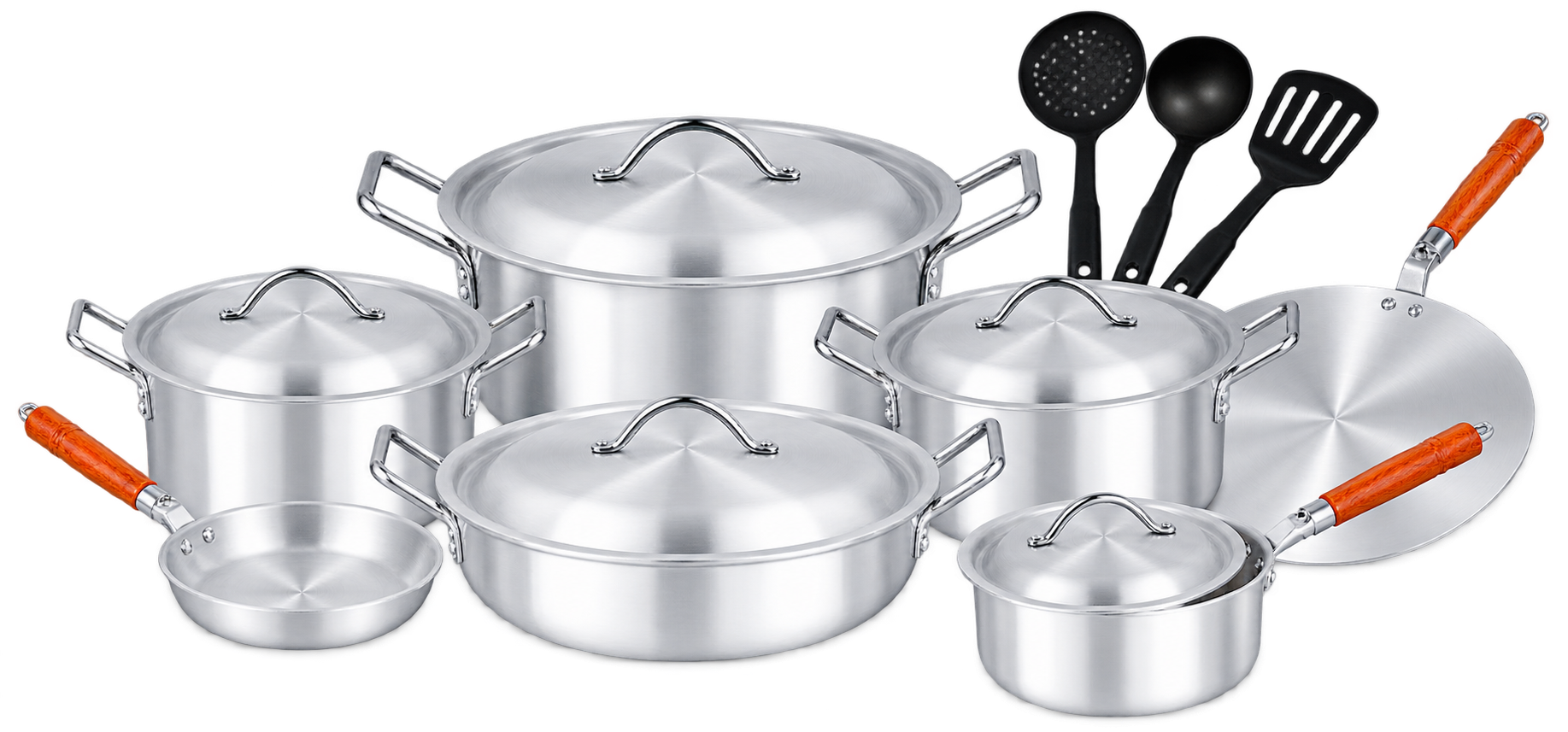
In this guide, we’ll explain the most important characteristics to look for when choosing a quality frying pan.
1. The Material Matters
One of the first things to consider when choosing a frying pan is the material used in its construction.
Different materials provide different characteristics, and the right option depends on the intended use.
Common cookware materials include:
- Aluminum
- Stainless steel
- Cast iron
- Carbon steel
- Coated cookware
- Multi-layer constructions
For commercial cookware buyers, material selection can also affect manufacturing requirements, product positioning, weight, cost, and target market.
A good frying pan should use materials appropriate for its intended application and product specifications.
2. Construction Quality
Material alone doesn’t determine whether a frying pan is good.
Construction quality is equally important.
Two frying pans made from similar materials can perform very differently depending on how they are manufactured.
Important construction factors include:
- Pan thickness
- Base construction
- Wall construction
- Handle attachment
- Surface finish
- Overall shape
- Manufacturing consistency
A well-constructed frying pan should feel stable and balanced when handled.
For cookware manufacturers and B2B buyers, consistent construction across production batches is particularly important.
3. Even Heat Distribution
Good heat distribution is another important characteristic of quality cookware.
A frying pan that heats unevenly can create hot spots. This may cause some areas of food to cook faster than others.
Good cookware design aims to distribute heat effectively across the cooking surface.
The exact performance depends on factors such as:
- Material
- Thickness
- Base design
- Construction
- Cooking surface
- Heat source
When evaluating cookware, don’t focus solely on appearance. Consider how the construction is designed to perform during actual cooking.
4. The Cooking Surface
The cooking surface plays a major role in how a frying pan feels and performs.
Two common options are:
Non-Stick Cooking Surfaces
Non-stick frying pans are designed to make food release easier.
They are particularly convenient for:
- Eggs
- Pancakes
- Fish
- Omelets
- Vegetables
- Delicate foods
Non-stick cookware can also make cleanup easier.
However, the cooking surface needs to be maintained according to the manufacturer’s recommendations.
Stainless Steel Cooking Surfaces
Stainless steel frying pans generally provide an uncoated cooking surface and are valued for durability and versatility.
They can be used for:
- Sautéing
- Frying
- Browning
- Searing
- General cooking
Stainless steel usually requires more attention to temperature and cooking technique than non-stick cookware.
5. Thickness and Weight
The thickness of a frying pan can influence its performance, durability, and handling.
A pan that is extremely thin may heat quickly but can potentially be less robust depending on its construction.
A heavier pan may provide greater stability, although excessive weight can make it less convenient to handle.
The ideal balance depends on the intended application.
For household cookware, users may prioritize comfortable handling.
For commercial applications, durability and repeated use may be more important.
For manufacturers and brands, thickness should therefore be selected according to the intended product positioning and market requirements.
6. A Comfortable Handle
The handle is one of the most overlooked parts of a frying pan.
A quality handle should provide:
- Comfortable grip
- Good balance
- Secure attachment
- Appropriate length
- Practical handling
The handle should also complement the size and weight of the pan.
For custom cookware projects, handle design can become an important part of product development.
Businesses developing private-label cookware may choose different handle styles to create a distinctive product identity.
7. A Well-Balanced Design
A frying pan should feel balanced when held.
If the handle is too heavy, too light, or poorly positioned, the pan may feel uncomfortable during cooking.
Balance becomes particularly important for larger frying pans because they may contain significant amounts of food.
A good cookware design considers the relationship between:
Pan + Handle + Weight + Cooking Surface
rather than treating each component independently.
8. Quality Finish
The finish of a frying pan contributes to both appearance and usability.
Depending on the product, finishes may include different exterior treatments, surface finishes, coatings, polishing, or colors.
A consistent finish is particularly important for cookware brands and retailers because customers expect products within the same collection to have a consistent appearance.
For OEM cookware, the finish can also contribute to brand identity.
9. Proper Size for the Intended Use
There is no single frying pan size that is perfect for everyone.
Different sizes serve different purposes.
Small Frying Pans
Suitable for smaller portions and individual cooking tasks.
Medium Frying Pans
A versatile option for everyday household cooking.
Large Frying Pans
Useful for larger portions, family meals, and certain commercial applications.
The best size depends on the intended cooking application.
For cookware businesses, offering multiple sizes can help create a more complete product range.
10. Compatibility With the Cooking Surface
Another important consideration is compatibility with the intended cooking environment.
Depending on the product design, cookware may be intended for different cooking surfaces or heat sources.
Before purchasing or manufacturing a frying pan, consider whether it is intended for:
- Gas cooking
- Electric cooking
- Ceramic cooking surfaces
- Induction cooking
- Other approved cooking environments
Always check the manufacturer’s specifications rather than assuming compatibility.
For OEM cookware projects, cooking-surface compatibility should be established during the product development stage.
11. Durability
A quality frying pan should be designed with durability in mind.
Durability depends on several factors, including:
- Material
- Thickness
- Construction
- Handle attachment
- Cooking surface
- Manufacturing quality
- Usage
- Maintenance
Stainless steel cookware is generally valued for long-term durability, while non-stick cookware requires appropriate care to protect its cooking surface.
A good cookware manufacturer should focus on the complete product rather than relying on one feature to define quality.
12. Easy Maintenance
A frying pan should be practical to maintain.
Non-stick cookware is often appreciated because food can release easily and cleanup can be relatively simple.
Stainless steel cookware may require more effort when food becomes stuck, but proper cooking technique and cleaning practices can make maintenance easier.
Before purchasing cookware, consider how much time you want to spend cleaning and maintaining it.
13. Manufacturing Consistency
This is especially important for businesses.
A single high-quality frying pan is not enough for a cookware brand.
If you’re ordering hundreds or thousands of products, you need consistent quality across the entire production run.
Manufacturing consistency can involve:
- Consistent dimensions
- Consistent thickness
- Consistent surface finish
- Consistent handles
- Consistent coating application
- Consistent product appearance
- Quality control procedures
For retailers, distributors, and cookware brands, reliable manufacturing consistency can have a direct impact on customer satisfaction.
14. Branding and Customization
If you’re purchasing cookware for your own brand, customization can be another important factor.
Depending on the manufacturer and product, customization may include:
- Brand logo
- Product finish
- Handle design
- Product dimensions
- Packaging
- Labels
- Product presentation
OEM and private-label cookware allows businesses to create products that are aligned with their own market and brand identity.
How to Choose the Right Frying Pan
Before purchasing a frying pan, ask yourself these questions:
What will I use it for?
Consider the foods and cooking techniques you use most frequently.
Which material is suitable?
Compare non-stick, stainless steel, and other available materials based on your cooking requirements.
What size do I need?
Choose a size appropriate for the number of people you normally cook for and the type of food you prepare.
How important is easy cleanup?
If convenience is a priority, a non-stick cooking surface may be attractive.
Do I need long-term durability?
If durability is your primary concern, consider the overall construction and material rather than focusing only on the surface.
Am I buying for a business?
If you’re purchasing commercially, also evaluate manufacturing consistency, customization, packaging, minimum order quantities, and supplier capabilities.
What Should Businesses Look for in a Frying Pan Manufacturer?
For retailers, distributors, importers, and cookware brands, selecting the right manufacturer is just as important as selecting the right product.
Look for a manufacturer that can provide:
Consistent Manufacturing
Products should meet agreed specifications across production runs.
Flexible Product Development
The manufacturer should be able to work around different product requirements.
Custom/OEM Capabilities
This is particularly important for brands developing private-label cookware.
Quality Control
Clear quality-control processes can help maintain product consistency.
Packaging Options
Retail-ready and custom packaging can be important for branded cookware.
Reliable Communication
A good manufacturing relationship depends on clear communication from product development through delivery.
ShineCookware — Frying Pan Manufacturing & Supply
At ShineCookware, we understand that cookware quality involves more than the appearance of the finished product.
Our frying pan solutions are designed for businesses looking for practical cookware products and reliable manufacturing options.
We work with businesses including retailers, distributors, hospitality companies, importers, and cookware brands.
For businesses developing their own cookware collections, custom and OEM frying pan solutions can also be discussed around product specifications, branding, and packaging requirements.
Explore our Frying Pans →
Frequently Asked Questions
What makes a frying pan high quality?
A high-quality frying pan combines suitable materials, solid construction, appropriate thickness, effective heat distribution, a practical handle, a suitable cooking surface, and consistent manufacturing quality.
What is the best material for a frying pan?
There is no single best material for every application. Non-stick, stainless steel, and other materials offer different advantages. The best choice depends on cooking requirements, durability expectations, maintenance preferences, and intended use.
Are heavier frying pans better?
Not necessarily. Weight should be balanced with durability, heat performance, stability, and ease of handling. The ideal weight depends on the cookware design and intended application.
How long should a quality frying pan last?
The lifespan depends on its material, construction, cooking surface, usage, and maintenance. Stainless steel cookware can offer long-term durability, while non-stick cookware requires appropriate care to protect its cooking surface.
What size frying pan should I buy?
A small pan may be suitable for individual portions, while medium and large pans can be more practical for everyday family cooking or larger meals. Your ideal size depends on your cooking habits and requirements.
Can I order custom frying pans for my brand?
Yes. Custom and OEM frying pan projects can be developed according to agreed product specifications, branding, and packaging requirements.
Final Thoughts
A high-quality frying pan is the result of thoughtful design, suitable materials, reliable construction, and consistent manufacturing.
When choosing cookware, don’t focus on a single feature. Consider the complete product — from the cooking surface and material to the handle, thickness, balance, durability, maintenance, and intended application.
For consumers, these factors can help create a better everyday cooking experience.
For retailers, distributors, and cookware brands, they can help create a more reliable and competitive product range.
Looking for quality frying pans for your business?
Explore ShineCookware’s frying pan range or contact us to discuss your wholesale, custom, or OEM cookware requirements.
In this guide, we’ll explain the most important factors to consider when choosing a cookware set.
What Is a Cookware Set?
A cookware set is a collection of coordinated cooking vessels designed to work together as a complete cookware solution.
Depending on the set, it may include combinations of:
- Frying pans
- Sauce pans
- Sauté pans
- Cooking pots
- Stock pots
- Lids
- Other cookware components or accessories
The exact contents vary from one set to another.
For this reason, it’s important to look beyond the number printed on the box and check exactly what the set contains.
A “10-piece” set, for example, may count lids as individual pieces. Another set with fewer pieces may actually contain more useful cookware.
1. Start With Your Cooking Needs
The best cookware set is the one that matches the way you actually cook.
Before choosing a set, think about the meals you prepare most frequently.
Do you regularly cook:
- Breakfast foods?
- Sauces?
- Soups?
- Pasta?
- Rice?
- Stir-fries?
- Vegetables?
- Meat?
- Large family meals?
If you mainly prepare simple everyday meals, you may only need a compact collection containing a frying pan, saucepan and medium or large cooking pot.
If you regularly prepare larger meals, a more comprehensive collection may be appropriate.
The goal is not to own the largest possible cookware collection. The goal is to have the right cookware available when you need it.
2. Check What Is Actually Included
One of the most important steps when choosing cookware sets is checking the contents carefully.
A useful cookware collection might include:
Frying Pans
Frying pans are useful for frying, sautéing, browning, eggs, vegetables and many everyday cooking tasks.
Having two different sizes can provide greater flexibility.
Sauce Pans
Sauce pans are useful for sauces, heating liquids, simmering, vegetables and smaller cooking tasks.
Cooking Pots
Larger pots are useful for soups, pasta, boiling and preparing larger quantities of food.
Lids
Matching lids can improve the functionality of pots and pans by helping retain heat and moisture.
The ideal combination depends on your cooking habits.
For businesses, the combination should also reflect the needs of the target market.
3. Consider the Cookware Material
Cookware materials have a major influence on cooking performance, durability, weight and maintenance.
Common options include:
- Stainless steel
- Aluminum
- Non-stick cookware
- Cast iron
- Carbon steel
- Multi-layer constructions
There isn’t one material that is perfect for every cooking application.
Stainless Steel
Stainless steel cookware is widely valued for durability and versatility. Its uncoated cooking surface can be useful for browning, sautéing and many other cooking techniques.
Some stainless steel cookware uses layered or combined constructions to improve heat distribution.
Aluminum
Aluminum is lightweight and conducts heat efficiently, making it a popular cookware material. It can also be used as part of layered cookware constructions.
Non-Stick Cookware
Non-stick cookware is designed to make food release easier and can be particularly convenient for delicate foods and everyday cooking.
It can also simplify cleanup, although the cooking surface should be cared for according to the manufacturer’s instructions.
Other Materials
Depending on the product range, cookware sets may also use materials such as cast iron, carbon steel or combinations of different materials.
The right choice depends on the intended cooking application, product design and user preferences.
4. Choose Between Non-Stick and Stainless Steel
For many buyers, one of the biggest decisions is whether to choose a non-stick cookware set or a stainless steel cookware set.
Non-Stick Cookware Sets
Non-stick sets can be particularly convenient for everyday cooking.
They are often useful for:
- Eggs
- Pancakes
- Fish
- Omelets
- Vegetables
- Foods that are more likely to stick
The easy-release surface can also make cleaning more convenient.
Stainless Steel Cookware Sets
Stainless steel sets are generally valued for durability and versatility.
They can be particularly useful for:
- Browning
- Sautéing
- Searing
- Sauces
- Boiling
- General cooking
Stainless steel cooking does require appropriate temperature control and technique because food can stick more readily than on a non-stick surface.
For many kitchens, the choice doesn’t have to be either-or. Different cookware surfaces can serve different cooking purposes.
5. Think About the Size of Each Piece
Size matters just as much as the number of pieces.
A cookware set may contain several pieces, but if all the pans are too small or too large for your cooking habits, the set may not be very practical.
Consider the number of people you normally cook for.
Small Cookware
Useful for individual portions, sauces and smaller cooking tasks.
Medium Cookware
A versatile choice for everyday household cooking.
Large Cookware
Useful for family meals, soups, pasta and larger quantities of food.
A well-planned cookware set should provide a useful range of sizes rather than simply maximizing the piece count.
6. Consider Your Cooktop
Before purchasing cookware, check whether the set is compatible with your cooking surface.
Depending on the product, cookware may be designed for:
- Gas cooktops
- Electric cooktops
- Ceramic cooktops
- Induction cooktops
Induction compatibility deserves particular attention because cookware needs suitable magnetic properties to work with an induction cooking surface.
If you’re buying cookware for your own kitchen, check the manufacturer’s specifications.
If you’re developing cookware for a brand, cooktop compatibility should be considered during the product-development stage.
7. Look at Construction Quality
The material is important, but it isn’t the only factor that determines cookware quality.
Pay attention to the overall construction.
Important considerations include:
- Thickness
- Base construction
- Handle attachment
- Shape
- Surface finish
- Balance
- Manufacturing consistency
A well-designed cookware set should feel cohesive, with pieces that are practical to handle and suited to their intended cooking tasks.
For cookware manufacturers and B2B buyers, consistent construction across an entire set is particularly important.
8. Don’t Ignore the Handles
Handles can have a major effect on the usability of cookware.
Look for handles that provide:
- A comfortable grip
- Good balance
- Secure attachment
- Practical positioning
- Suitable proportions
The handle should also be appropriate for the size and weight of the cookware piece.
For custom cookware sets, handle design can become part of the overall identity of the collection.
9. Check the Lids
Lids are often overlooked when choosing cookware sets.
A good lid should fit the corresponding cookware piece appropriately and provide practical coverage.
Depending on the product design, lids may be made from different materials and may have different handle styles.
When comparing cookware sets, check whether the listed piece count includes lids.
This makes it easier to compare one set with another fairly.
10. Consider Storage Space
A large cookware set can be useful, but it also takes up space.
Before choosing a set, consider where you’ll store:
- Frying pans
- Sauce pans
- Cooking pots
- Lids
- Additional accessories
Some cookware sets are designed so pieces can be nested together, helping reduce storage requirements.
If your kitchen has limited cabinet space, a smaller, well-selected cookware collection may be more practical than a large set.
11. Think About Maintenance
Different cookware materials require different levels of care.
Non-stick cookware is often chosen for its convenient food release and relatively easy cleanup.
Stainless steel can require more attention during cooking and cleaning, particularly when food becomes stuck.
Your cookware should fit not only your cooking habits but also your preferred maintenance routine.
Always follow the manufacturer’s care and cleaning recommendations for the specific cookware.
12. Consider Durability
If cookware is going to be used frequently, durability becomes an important consideration.
A quality cookware set should be designed around appropriate materials, construction and manufacturing standards.
For consumers, durability can mean better long-term value.
For retailers and cookware brands, durability can also influence customer satisfaction, product reputation and repeat purchases.
This is why product quality should be evaluated as a complete system rather than based on one specification alone.
13. Look Beyond the Piece Count
One of the most common mistakes when choosing a cookware set is assuming that more pieces automatically mean better value.
Instead, ask:
How many of these pieces will I actually use?
A smaller collection containing essential cookware may be more useful than a large set filled with pieces that rarely leave the cupboard.
Look at:
- Number of frying pans
- Saucepan sizes
- Pot sizes
- Number of lids
- Useful accessories
- Storage requirements
- Actual cooking needs
The ideal cookware set is the one that provides practical coverage without unnecessary pieces.
14. Consider Your Budget and Long-Term Value
Price is naturally an important factor when choosing cookware.
However, the cheapest set isn’t always the most economical choice over the long term.
Consider the relationship between:
Price + Quality + Durability + Functionality
A well-designed cookware set that performs reliably for years may provide better value than a cheaper set that needs frequent replacement.
For businesses, additional factors may include:
- Production cost
- Packaging
- Minimum order quantity
- Product specifications
- Branding
- Shipping
- Target retail price
15. Choosing a Cookware Set for Your Business
The buying process is different when you’re sourcing cookware for a business.
Retailers, distributors, importers and cookware brands should consider more than just cooking performance.
Important factors include:
Product Selection
Does the manufacturer offer the cookware pieces you need?
Consistent Manufacturing
Can the manufacturer maintain consistent specifications across production?
Customization
Can the set be developed around your desired combination of products?
Branding
Can your company branding be incorporated into the cookware or packaging?
Packaging
Can the set be supplied in packaging appropriate for your market?
Production Capacity
Can the manufacturer support your required order quantities?
These factors become particularly important when developing a private-label or OEM cookware collection.
Custom & OEM Cookware Sets
For cookware brands, a standard set may not always be the right solution.
Custom cookware manufacturing allows businesses to develop collections around their own requirements.
Depending on the project, customization may involve:
- Product selection
- Number of pieces
- Cookware sizes
- Materials
- Cooking surfaces
- Handles
- Finishes
- Branding
- Labels
- Packaging
This approach allows a cookware business to create a collection designed specifically for its target customers.
How Many Pieces Should a Cookware Set Have?
There is no universal number that works for every kitchen.
A practical set might contain several essential pans and pots, while a larger collection may include additional cookware for specialized cooking.
The important thing is to evaluate the actual contents rather than the advertised piece count.
For example, a set containing a frying pan, saucepan, cooking pot and matching lids may be more useful to one household than a much larger collection containing several rarely used pieces.
A Simple Cookware Set Checklist
Before choosing a cookware set, ask these questions:
What do I cook most often?
Choose cookware around your actual cooking habits.
Which material suits my needs?
Compare non-stick, stainless steel and other available materials.
What pieces do I actually need?
Focus on useful cookware rather than the highest piece count.
What sizes should I have?
Choose a practical combination of small, medium and large cookware where appropriate.
Is the set compatible with my cooktop?
Check the manufacturer’s specifications, especially for induction.
How easy is it to maintain?
Consider cleaning and care requirements.
How durable is the construction?
Look beyond appearance and evaluate materials and construction.
Am I buying for a business?
Consider customization, branding, packaging, production consistency and supplier capabilities.
Cookware Sets from ShineCookware
At ShineCookware, we understand that cookware sets need to balance functionality, design and practical product requirements.
We manufacture and supply cookware solutions for retailers, distributors, hospitality businesses, importers and cookware brands.
For businesses developing their own collections, custom and OEM cookware set solutions can be discussed around product selection, specifications, branding and packaging requirements.
Whether you’re looking for a standard cookware collection or developing a private-label range, our team can work with you to understand your requirements.
Explore our Cookware Sets →
Frequently Asked Questions
What should a good cookware set include?
A useful cookware set should include pieces that match your cooking requirements. Depending on the set, this may include frying pans, sauce pans, cooking pots and matching lids.
Is a larger cookware set better?
Not necessarily. A larger set is only better if you will actually use the additional pieces. Focus on the cookware you need rather than choosing a set based only on its piece count.
Is non-stick or stainless steel better for a cookware set?
Both have different advantages. Non-stick cookware is convenient for food release and everyday cooking, while stainless steel is valued for durability and versatility. Your choice should depend on your cooking style and preferences.
Are stainless steel cookware sets durable?
Stainless steel cookware is generally valued for its durability and versatile uncoated cooking surface. Actual performance depends on the material, construction and manufacturing quality.
Are cookware sets compatible with induction cooktops?
Some cookware sets are induction compatible and others are not. Always check the manufacturer’s specifications before purchasing.
Can I create a custom cookware set for my brand?
Yes. Custom and OEM cookware sets can be developed around your preferred products, sizes, materials, branding and packaging requirements.
Can cookware sets have custom packaging?
Yes. Custom packaging can be discussed for retail, wholesale, OEM and private-label cookware programs.
Do you supply cookware sets wholesale?
Yes. ShineCookware supplies cookware solutions for businesses including retailers, distributors, hospitality businesses, importers and cookware brands.
Final Thoughts
Choosing the right cookware set isn’t about finding the set with the most pieces.
It’s about finding the right combination of cookware for the way you cook.
Consider the materials, cooking surfaces, sizes, construction, handles, lids, maintenance requirements and cooktop compatibility before making your decision.
For businesses, the evaluation should go further. Manufacturing consistency, customization, branding, packaging and supplier capabilities can all influence the success of a cookware collection.
A well-designed cookware set can provide a practical foundation for everyday cooking while giving cookware brands and retailers an opportunity to create a coordinated product collection.
If you’re looking for cookware sets for your business, explore ShineCookware’s cookware solutions or contact us to discuss your wholesale, custom or OEM requirements.
| Non-Stick Cookware | Stainless Steel Cookware |
|---|---|
| Advantages | Advantages |
|
|
| Disadvantages | Disadvantages |
|
|
How to Choose Between Non-Stick and Stainless Steel Cookware
Ask yourself the following questions before making a decision:
1. What foods do you cook most often?
If you regularly prepare delicate foods, non-stick cookware may be more convenient.
2. How important is easy cleanup?
If quick and easy cleanup is a priority, non-stick cookware can be attractive.
3. Do you prioritize long-term durability?
If durability and an uncoated cooking surface are major priorities, stainless steel may be the better choice.
4. What cooking techniques do you use?
Think about whether you mainly fry, sauté, brown, simmer, boil, or prepare delicate foods.
5. How much cookware do you need?
Instead of choosing one material exclusively, consider combining different cookware types according to your cooking needs.
What Should Businesses Consider When Buying Cookware?
For businesses, the decision between non-stick and stainless steel cookware involves more than individual cooking preferences.
Retailers, restaurants, hospitality businesses, distributors, and cookware brands should consider:
-
Product quality
-
Material specifications
-
Coating requirements
-
Product sizes
-
Handle designs
-
Manufacturing consistency
-
Packaging
-
Branding
-
Production capacity
-
Quality control
-
Order quantities
-
Customization options
Businesses developing their own cookware range may also benefit from working directly with a manufacturer that can provide custom or OEM production.
Non-Stick and Stainless Steel Cookware from ShineCookware
At ShineCookware, we understand that different kitchens and businesses have different cookware requirements.
Our cookware range includes both non-stick and stainless steel products, alongside frying pans, sauce pans, cookware sets, kitchen utensils, and pressure cookers.
For businesses looking for customized products, ShineCookware also offers custom and OEM cookware solutions designed around specific product and branding requirements.
Whether you are sourcing cookware for retail, hospitality, foodservice, distribution, or your own cookware brand, choosing the right material is an important part of developing a reliable product range.
Frequently Asked Questions
Is non-stick better than stainless steel?
Neither is universally better. Non-stick cookware is convenient for easy food release and cleanup, while stainless steel cookware is valued for durability, versatility, and an uncoated cooking surface.
Which lasts longer, non-stick or stainless steel?
Stainless steel cookware can generally provide long-term durability because it does not rely on a coating that can wear down. The lifespan of either type also depends on construction, quality, usage, and maintenance.
Is stainless steel harder to cook with?
It can require more attention to temperature, preheating, and cooking oil than non-stick cookware. With the right technique, stainless steel can be highly versatile.
Is non-stick cookware good for everyday use?
Non-stick cookware can be very convenient for everyday cooking, particularly for foods that tend to stick. Users should follow the manufacturer’s care and temperature recommendations.
Should I buy both non-stick and stainless steel cookware?
For many kitchens, having both can be useful. The two materials offer different cooking characteristics and can complement each other.
What is better for a cookware business: non-stick or stainless steel?
It depends on the target market and product strategy. Offering both can allow a cookware business to serve customers with different preferences. Businesses should also consider product specifications, manufacturing capabilities, quality requirements, packaging, and customization.
Final Thoughts
The choice between non-stick and stainless steel cookware ultimately comes down to your cooking requirements.
Non-stick cookware offers convenience, easy food release, and simple cleanup, making it a popular choice for everyday cooking. Stainless steel cookware offers durability, versatility, and an uncoated cooking surface, making it suitable for a wide range of cooking applications.
For many kitchens, the best solution is not choosing one over the other but using both for different purposes.
For cookware retailers, distributors, hospitality businesses, and brands, the decision should also include product quality, manufacturing consistency, customization, packaging, and long-term supply capabilities.
Looking for non-stick, stainless steel, or custom cookware for your business? Explore ShineCookware’s cookware range or contact us to discuss your requirements.